
Dr Stuart Turner MA (Cantab) MB BChir MD FRCP (Lon) FRCPsych is a retired consultant psychiatrist.
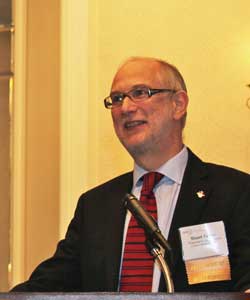
Honours:
- The International Society for Traumatic Stress Studies, Sarah Haley Memorial Award, for Clinical Excellence.
- The Wolter de Loos Award for Outstanding Contribution to Psychotraumatology in Europe.
Education:
- Chesterfield Grammar School, 1963 to 1969.
- Matriculated 1970, Gonville and Caius College, Cambridge.
- Graduated, 1973, Cambridge, BA in medical sciences - experimental psychology and pharmacology.
- Awarded a Clinical Exhibition and the 'Tancred Studentship in Physic'.
- Undergraduate training at the Middlesex Hospital (winning the psychiatry prize).
- Passed final medical examinations (MB BChir) in Cambridge, 1976.
Postgraduate Training:
- Training in Medical Specialties (neurology, renal and metabolic, cardiology) in Hull.
- Passed the MRCP (UK) qualification in general medicine.
- Subsequent election to the Fellowship (FRCP) of the Royal College of Physicians in London.
- General Psychiatric training (1979 to 1983) at the Middlesex Hospital, to work with his undergraduate tutor, Dr Edward Chesser, and receive clinical training in cognitive-behaviour therapy at a centre of excellence, working with Dr Vic Meyer, the pioneer of exposure and response prevention in the treatment of OCD. He received a broad base of supervised clinical training in psychological therapies eg in cognitive-behavioural, psychodynamic, group analytic, with individuals, couples and as facilitator of a closed psychotherapy group.
- Passed the MRCPsych qualification in psychiatry.
- Subsequent election to the Fellowship (FRCPsych) of the Royal College of Psychiatrists.
- Research Fellow, and then Lecturer, at Kings College Hospital and the Institute of Psychiatry (1983 to 1987), undertaking research into the biology of schizophrenia leading to the Cambridge University MD degree (equivalent to a PhD).
- Higher training in psychiatry, especially in liaison and neuropsychiatry.
- As Lecturer, responsible for negotiating and drafting revised undergraduate teaching programme.
Consultant and University Appointments:
- Senior Clinical Lecturer Middlesex Hospital Medical School (later UCL) and honorary consultant, 1987 to 1993.
- Senior Consultant, Psychiatric Intensive Care Unit, St Lukes-Woodside Hospital.
- First Medical Director, Camden and Islington NHS Community Trust (1993 to 1998)
- Substantive NHS consultant post, honorary senior lecturer, UCL (1993 to 2003)
- Chair of the Psychology Commisioning Group (N Thames), responsible for funding DClinPsy training programmes
- Director of Research and Development, North Central London Community Research Consortium (now NoCLoR).
- Chair, Mental Health Steering Group, North Central London Workforce Development Confederation.
- Vice-Dean, Royal Free and University College Medical School.
- Emeritus Consultant, Camden and Islington Mental Health Trust (2003 to current).
Trauma Experience:
- In the mid 1980s, Volunteer and then Trustee of what was then called the Medical Foundation for the Care of Victims of Torture (now Freedom from Torture).
- One evening, whilst seeing patients in the Medical Foundation, he became aware of the emergency services' sirens on the Euston Road, and learned of the 1987 fire at Kings Cross Station. With James Thompson, he played a lead role in establishing the NHS response to this disaster and was often consulted in the aftermath of other similar incidents across the United Kingdom.
- As a direct result of his research into the emotional condition of the British "human shield" civilians returned from Kuwait and Iraq, undertaken with Dr Jeff Easton, the UK Department of Health was persuaded to support the development of specialist trauma services (see Sir Edward Heath's Autobiography).
- He co-directed, with Dr James Thompson, one of the two nationally funded NHS centres for treating trauma survivors, at the Middlesex Hospital.
- Director of the Traumatic Stress Clinic, after its move to Charlotte Street.
- Particular experience in working with people with complex problems. As well as establishing services for survivors of torture, he has been involved in establishing a DBT service for people with borderline disorders, and has been asked to help many survivors of sexual assault and rape, those who choose to see a male therapist.
- One of the four clinicians (with Roderick Orner, Atle Dyregrov, and Wolter de Loos) who established the European Society for Traumatic Stress Studies (ESTSS), having been Chair of the European Trauma Foundation, the precursor organisation.
- Second President of ESTSS.
- Established and chaired the UK Trauma Group, a managed clinical network of lead practitioners and researchers in the UK, for 8 years.
- Elected to the Board of the International Society for Traumatic Stress Studies (ISTSS) and served as Secretary, Treasurer and Vice-President.
- Elected by the members as President of ISTSS, only Briton so far to be so elected.
Trusteeships:
- Medical Foundation for the Care of Victims of Torture.
- He is a former Trustee of Redress, an organisation working for reparation for survivors of torture. Redress was one of the NGOs involved in the Pinochet extradition trial representing the victims of torture in Chile. It also played a role in defining terms for the International Criminal Court (ICC).
- He is former Chair of Trustees of the Refugee Therapy Centre, a London-based service specialising in offering same language counselling for young refugees and asylum seekers.
- With Dr Jane Herlihy, he co-founded the Centre for the Study of Emotion and Law.
Medicolegal Work:
- He is committed to principles of justice and fairness. He has extensive experience in court work (civil, immigration, family, criminal and international).
- Gave evidence to the Macpherson Inquiry after the death of Stephen Lawrence.
- Gave evidence in the case of Yuri Budanov, a Russian officer convicted of kidnap and murder in Chechnya (see Anna Politkovskaya, Putin's Russia: Life in a Failing Democracy).
- Gave evidence in the International Criminal Tribunal for the former Yugoslavia (ICT-Y) in relation to the shelling of Sarajevo.
Other Roles have included:
- initial Faculty Member on a course for the Care of the Critically Ill Surgical Patient for the Royal College of Surgeons.
- Secretary for the British Association of Mental Health and Law.
- Civilian consultant adviser in trauma to the UK Director of Defence Psychiatry.
- Member of a panel inspecting the Healthcare Services in Yarls Wood IRC on behalf of HM Chief Inspector of Prisons and the following year was involved in an inspection of a special unit at HMP Long Lartin. He has since been an inspector at Belmarsh and the CSC units.
- Overseas, he has been involved in training and other projects in Gaza. Tbilisi (Georgia), Sri Lanka and Namibia.
- Chaired an international project. group for the ISTSS in collaboration with the UN on organised state violence.
- Representative to the UN, on behalf of ISTSS.
- member of the Guideline Development Group for the PTSD guidelines published in 2005 by the National Institute for Health and Clinical Excellence (NICE).
- Member of the Advisory Group to the Dart Centre in Europe.
- Temporary adviser to the Trauma, PTSD and Dissociative Disorders subworkgroup for the APA revision of the DSM, convening a special one-day session on this topic within his Presidential conference in Chicago.
- Associate editor of the European Journal of Psychotraumatology for the first five years of its life.
- Invited keynote speaker at the First Australia and New Zealand Refugee Trauma Recovery in Resettlement Conference, March 2017, Sydney Australia.
Publications:
- Please click here to see a list of publications.